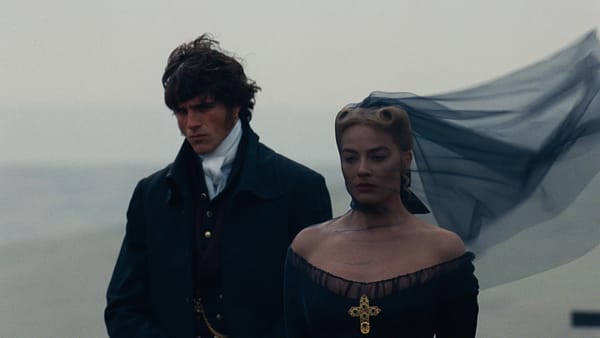
Ciaran Hinds and Polly Findlay Talk Amsterdam and Taking a Midwinter Break
The pair discuss working with Lesley Manville and the nature of adaptation

This post is free but it’s worth it to become a paid member of The Film Maven community! Paid subscribers are the backbone of The Film Maven who support independent journalism, as well as female- and disabled-created content. Paid Film Mavens get access to two-three exclusive articles a week including access to my series The Trade and Popcorn Disabilities, as well as the ability to chat with me on The Film Maven's Discord server.
Don't want to commit to a subscription? Leave a tip to show you enjoy what you're reading.
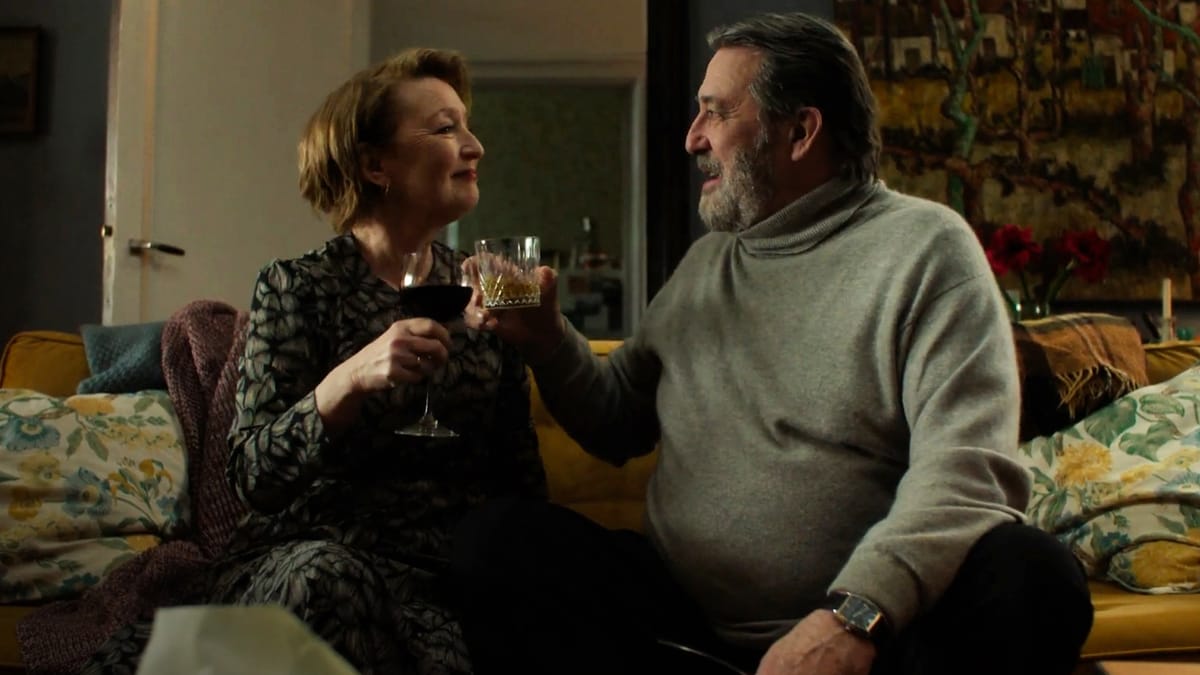
There's a beauty in the simplicity of director Polly Findlay's Midwinter Break. The story of a long-married couple (Ciaran Hinds and Lesley Manville) who attempt to shake things up by visiting Amsterdam opens up to discussions of personal beliefs, how love changes as we age, and how we reconcile with historical trauma that touches us.
From the minute Findlay knew she'd be working on the story the hope was to cast Lesley Manville as the extremely devout Stella, a woman hoping to give back for the second chance in life she was given as a younger woman. "Lesley is somebody that I've known for a long time and she had always said, as my friend, 'When you make your first film I'll do it with you.' And then she actually did," Findlay tells The Film Maven.
Findlay couldn't have thought of anyone besides Hinds and Manville for their parts because, as she says, they have an ability to show you "the iceberg underneath the surface." Much of the stakes found in the movie are inhabited in the internal relationship roiling between the two, the years of history between them, and what remains unspoken.
"I feel like you can see the full cross section of all the emotions with both Lesley and Ciaran," she says. "You have to have actors that can make everything clear without over explaining it. That's really rare to have people that can do it so well, and they were so well matched in their ability to do that."
While Hinds and Manville have been working for decades, the Irish actor admitted they've never worked together before, though he was certainly aware of Manville. Hinds was also aware of the book the movie was based on, having read Bernard MacLaverty's book when it came out (he also knew MacLaverty from their days at university). "It's this quiet, autumnal kind of love gone stale [story]," he says. "But is there hope? It's very beautiful, a very beautiful novel. Then I gave it to a friend and I thought no more about it. I didn't know four, five years later, we were going to now operate in it. I was thrilled when I was asked to be in it because it had touched me as a piece."
He and Manville spent at least three days talking to each other, alongside Findlay. "It's not a question of what I'm going to do," he says. "It's about the human interaction. And [Findlay's] job was to [ask] how do I do that on camera? How close and how far? She just let us at it. It was lovely, actually, for us to find each other in it, Lesley and myself."
It was certainly helpful that Hinds, Manville, and Findlay all had theater backgrounds, as that crafted a shorthand that benefited the shooting schedule. The movie is very much a two-hander with a stage-like quality. The only two performers of significance are Manville and Hinds.
"We did a kind of accelerated version of some of the stuff that you would do in a theater rehearsal room," says Findlay. "Around building back history, and a sense of shared events, and understanding the shared past that these characters are bringing to the table. The thing that felt different was that, in a theater process, what you're doing is building a structure that allows actors to repeat, because they have to do the same thing night after night after night, whereas this process was much more about capturing the moment of improvisation." Findlay would set the scene and create an environment where the actors had space and time to react and be reactive.
Findlay explained that much of the backstory that was created did end up on-screen, a fact only enhanced by how rich the original novel was. "We also had a lot of conversations about things like the way that Jerry [Hinds's character] had costumed himself over the years, and the costume that you see is the product of all of those conversations," says Findlay. "But there's loads of little details underpinning that that are just things that we made up."
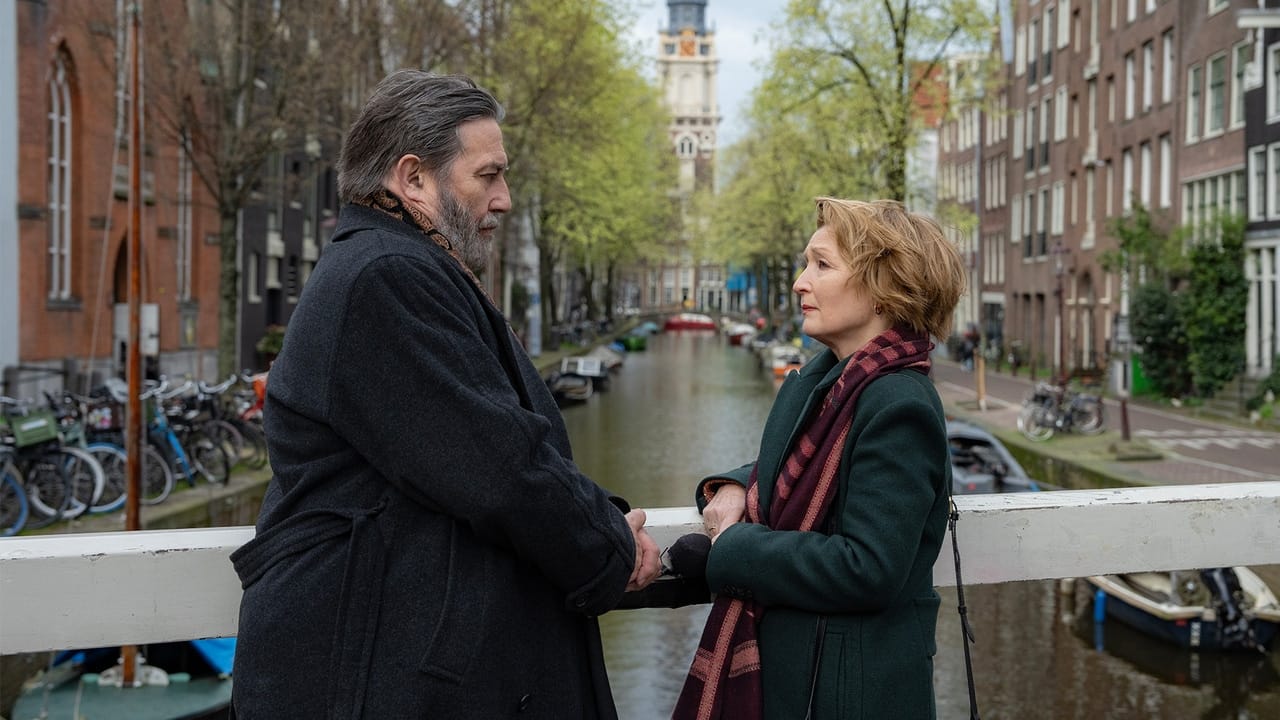
Once that 72-hour rehearsal period was up they also had to make room for a fourth character: that of Amsterdam, the location where Stella believes she might finally be able to atone for her past. "We talked from the beginning about Amsterdam being a character in its own right," says Findlay. "The city itself did us a lot of favors in that it is so extremely beautiful and so cinematic, and carries with it a sense of poetry or lyricism around every corner. The joke that we had when we were making it was that my choices were either point a camera at Lesley, or at Ciaran, or Amsterdam."
"When you're actually in front of a camera, you're somewhere else," says Hinds. "You're aware of what's around you, but because you're connecting more with the person that you're working with, Lesley, you're focused on the person than the geographical landscape. But then they go cut and...you've got all that time to see how marvelous the location you're in. I had not been in Amsterdam...probably for my best friend's wedding about 35 years before and I was only literally there for a day and a half. We were there [filming] for four and a half weeks so I got to explore it on the weekend."
Midwinter Break hits theaters this Friday.

![Gore Verbinski and Cast Talk the Urgency of Good Luck, Have Fun, Don't Die: 'The World Is Screaming the Answer' [Video]](/content/images/size/w600/2026/02/MV5BMzMyMzgwMzYtMjFjNS00YmQ4LWEzNWMtNzI2YTI3MDAyZTUyXkEyXkFqcGdeQWFkcmllY2xh._V1_.jpg)