Emerald Fennell's Wuthering Heights Hits HBO Max May 1st With a Unique ASL Version You'll Want to See (Exclusive)
The Film Maven got exclusive access to the new way the ASL interpretation will be presented on-screen

This post is free to enjoy but it's worth it to become part of my exclusive Gold Star Crew of Silver and Gold Film Mavens.
🌟Supporters like: Jason Reynal, Lawrence Carter-Long, Media Path Podcast, Shupei, Ethan Luce, Jeremy Fuster, Lgdfry, Julie Ruth Cohen, Sabbamonte and Childe.Dirk💫
Paid subscribers are the backbone of The Film Maven who support independent journalism, as well as female- and disabled-created content. Paid Film Mavens get access to shout-outs, exclusive articles and series, Zoom mixers, and The Film Maven Discord server.
Consider becoming a paid subscriber and joining the community that invests in independent journalism free of AI and influencer opinions!
There's an interesting movement in disabled accessibility in the media right now. Where we're still leaps and bounds – or, as Annenberg continues to show, utterly stagnant – with regards to disabled representation on-screen, there's been an uptick in the desire to craft new means of inserting accessibility into cinema. We saw it earlier this week with Disney's Songs in Sign Language series, proving that ASL can be integrated into animation. HBO Max has been in the on-screen ASL dubbing space for awhile now, starting with 2023's Barbie and continuing with the likes of Sinners, The Pitt (where they actually used Deaf ER doctors to consult), and One Battle After Another.
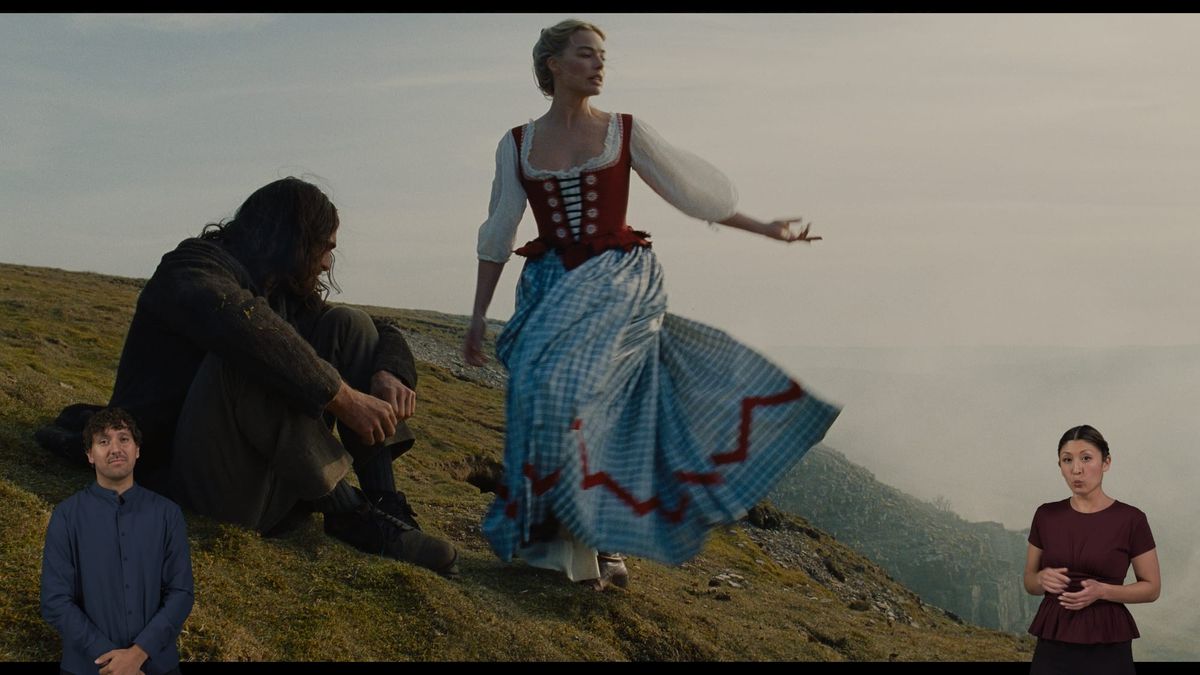
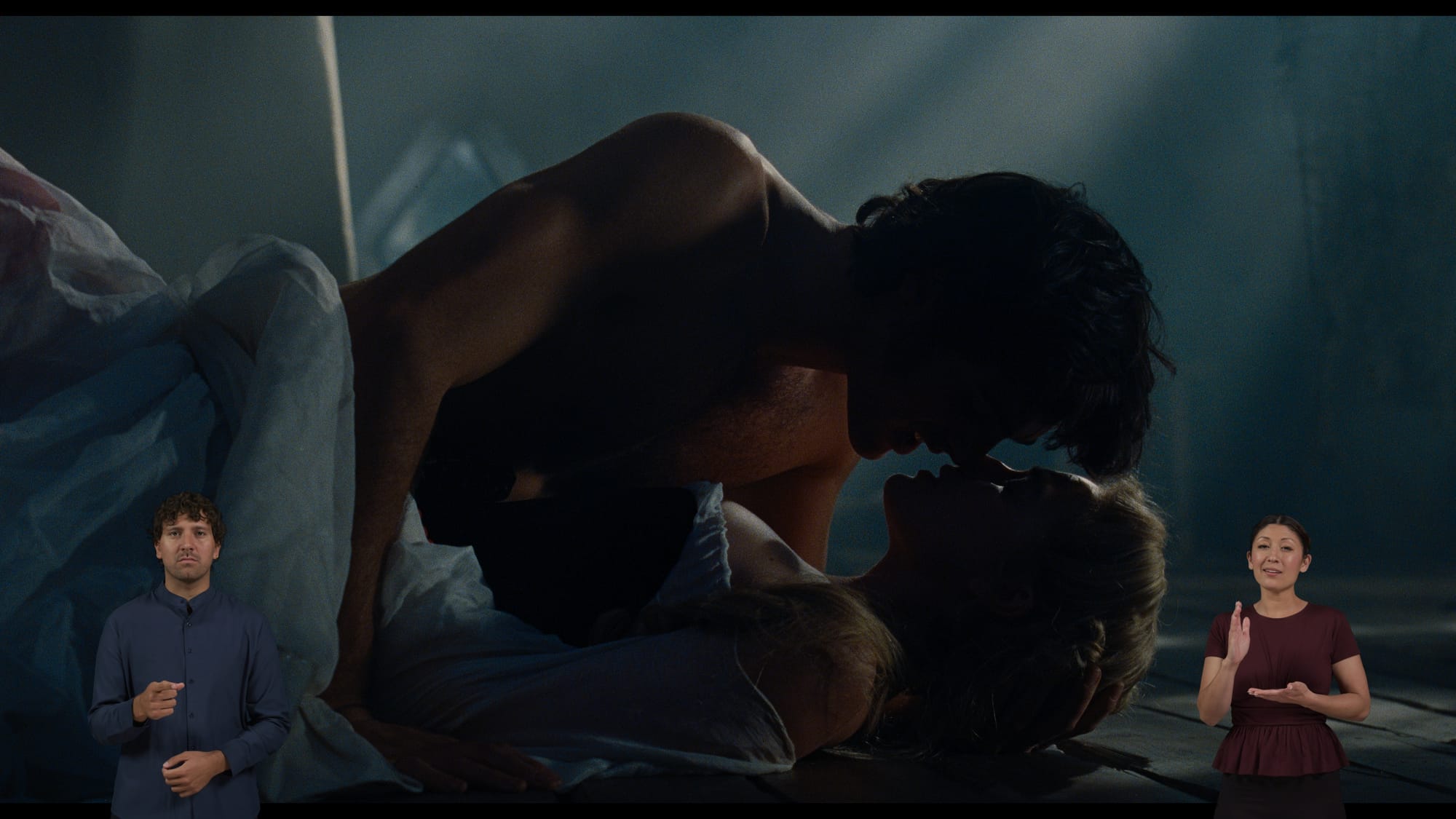
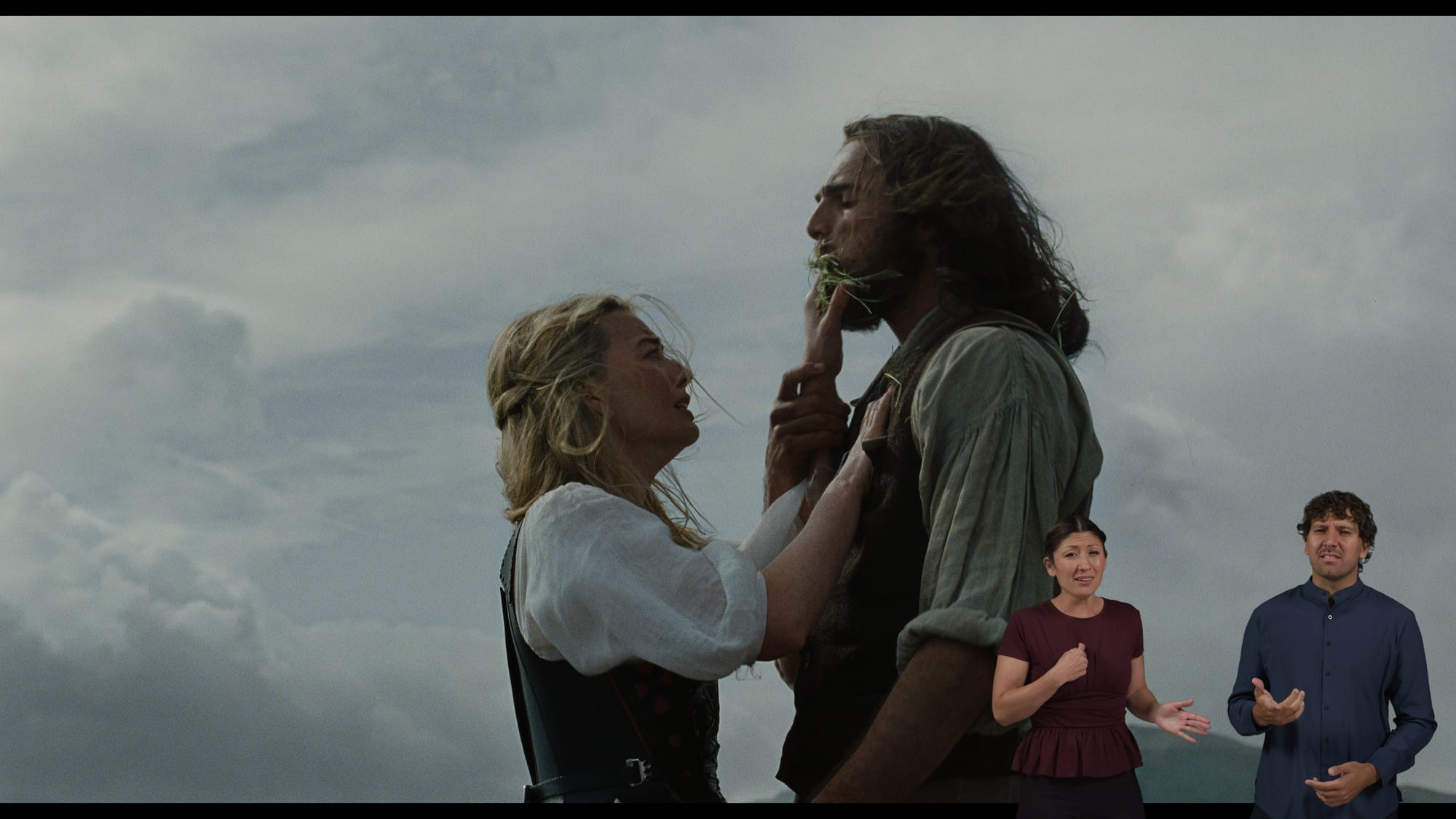
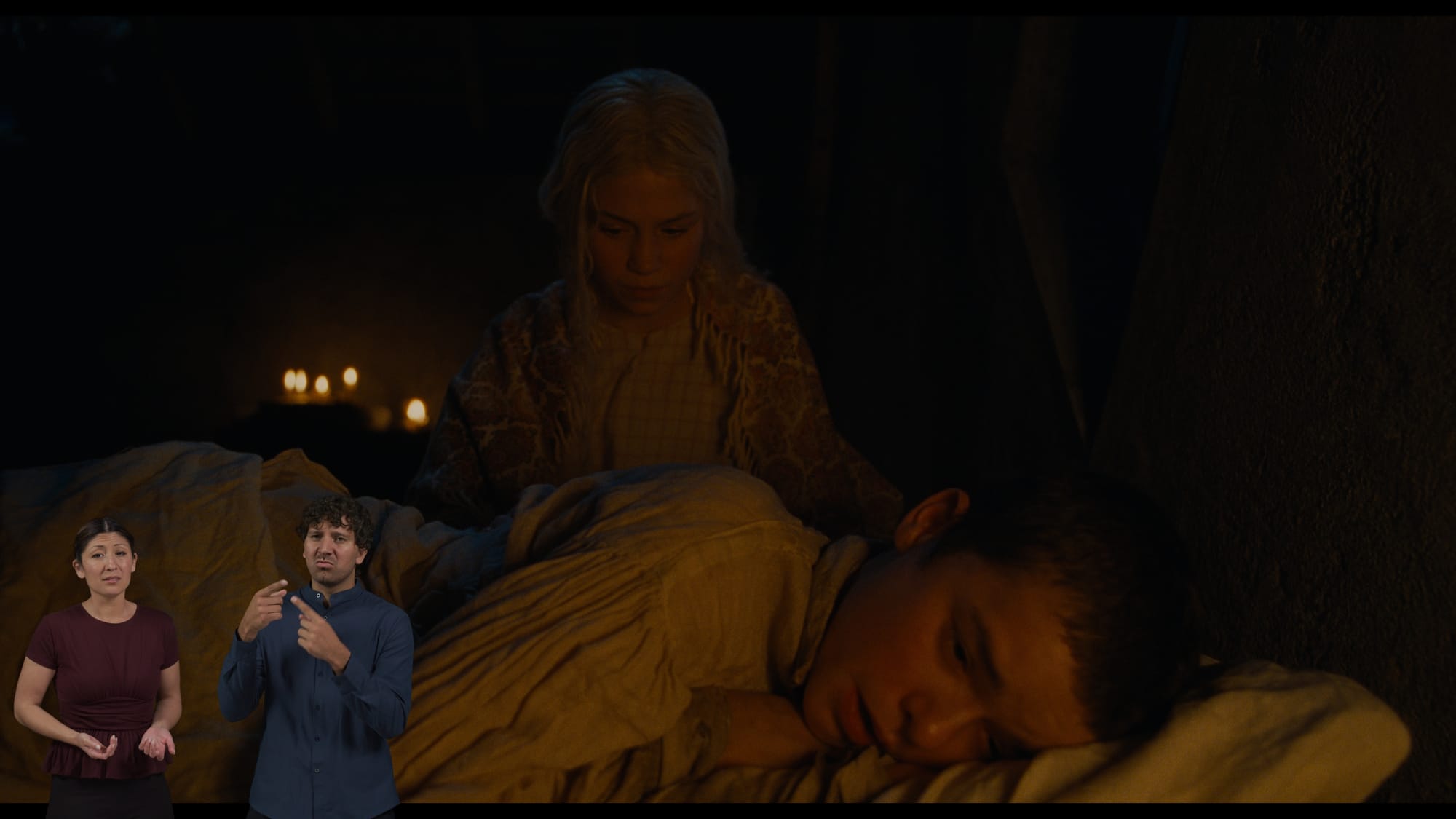
But with the announcement that Emerald Fennell's "Wuthering Heights" will air on HBO and HBO Max starting May 1st, the studio also wanted to do something new with the ASL dubbing field: not just have the dubbers translate the words Jacob Elordi and Margot Robbie say on-screen, but act out the heady emotions and feelings Fennell is placing on-screen. And because doomed lovers Heathcliffe (Elordi) and Catherine (Robbie) are a package deal, "Wuthering Heights" will be the first movie to feature two ASL dubbers interacting with each other on-screen.
HBO Max' accessibility team invited me exclusively to visit the Roundabout Studios where the filming of the dubbers took place, giving me unprecedented access to a new way to watch movies in general that was incredible to witness. On this day, I was invited to watch dubbers Giovanni Maucere and Leila Hanaumi (who also interpreted Margot Robbie in the ASL version of Barbie) do pick-ups – redoing lines that needed to be tweaked – no different than on any other film set.
Ordinarily, because an ASL interpreter's job is to just relay information, their appearance is meant to be as non-distracting as possible, their hair worn back and their clothes reserved. Director of ASL (known as a DASL) Justin Jackerson, a member of the Deaf community alongside Maucere and Hanaumi, wanted to make sure viewers saw the dubbers as an extension of the characters themselves. So when Heathcliffe transitions from the poor man working at Thrushcross Grange to returning a rich man, Jackerson and Maucere decided Maucere should wear an earring like Heathcliffe does. Similarly, Hanaumi wears her hair braided, evocative of Catherine's hair. The pair's wardrobe is a bit more form-fitting and akin to the time period. All of this is to evoke the notion that these two are as bonded as the characters whose words they're signing on-screen.
Even the concept of what the performers are called – dubbers – implies a deeper awareness of what Hanaumi and Maucere are doing compared to a standard interpreter. "It did take us maybe two years to figure out what to call us," Hanaumi tells The Film Maven. The term "interpreter" was perceived as reserved strictly for someone trying to translate ASL into English, and vice versa, for a conversation between hearing and Deaf participants.
"There is also an acting aspect of it," she says. "We're [going] from one language to another. It's just so much more visual on screen. So, finally, we got to dubbing. We are ASL dubbers and I think that captures the complex nature of this work. We are not just translating the lines into ASL. We are also copying all of the characters on the screen to make sure that our bodies are in the right position, our face and our body language match accurately to each character."
As Hanaumi tells me during an interview, the first Deaf person she ever saw was Sesame Street icon Linda Bove. Seeing straightforward ASL on-screen was "profound" for Hanaumi as it showed that Deaf people and ASL had a place, not only in television but in the world. It's something that, as Hanaumi says, got lost with the rise of baked-in closed captioning. "Obviously it was a great thing," she explains. "But one thing that got lost is the ASL on the screen, because people assumed that if we have captions on the screen, then that's good enough...So not a lot of Deaf representation on screen [means there's] also not a lot of ASL representation."
Everyone agrees that, even if there is ASL in content, movies have historically framed the scenes in a way where an actor's signs get cut off, or the movie doesn't utilize ASL throughout the whole feature. "There is a spectrum of deafness," says Jackerson. "There's a lot of Deaf people who are fine with just reading the captions. For a very long time, it's been that way. There's some Deaf people who don't really have the access and capability of reading the captions and understanding it, so they use their first language of ASL....But doing this kind of work, I see myself on screen, and I wonder who is watching me? Or who's watching this?"
Hanaumi, who has two Deaf children ages nine and six, says her kids will often choose to watch the ASL version of a movie rather than watch captions as they can often understand it better. For her, these movies often help young Deaf children connect to movies better, particularly if they're too young to read but aren't too young to have learned signing. "People, in general, when they watch movies, they'll pick famous lines from movies and they'll use it in their everyday English," says Maucere. "But Deaf people, we'll translate it from English into ASL. These moments are really hitting now with an ASL dubber in it...and Deaf people can now be involved, and they'll say those phrases from famous movies that we in English always say. So it kind of is able to be accessible in both ways."
Everyone working on this production feels a sense of pride for what they're doing, particularly Maucere, who was the ASL dubber for Superman. "I've seen a lot of kids, Deaf children specifically, who always felt like they had light in their eyes. They had never seen anything like that before. ASL for a superhero on HBO?...Really, it's just groundbreaking and it hits home."
There's a technical precision to watching the pair work. Jackerson blocks out how the two will stand next to each other on-screen, making sure there's ample room for them to sign. This is also checked by a person in the central control booth, watching the pair in the ASL box alongside the movie to make sure the actors are of even height and will fit within the frame. "When Leila will show up, or when she'll disappear, or when they share the screen at the same time together, maybe they'll be on different sides," says Jackerson. "If Catherine is on the left side or Heathcliff is on the right side I would like the dubbers to match each one. So, sometimes when they switch positions it's like, what do you do? Then you have to figure that out. Timing really makes a big difference."
There are moments of humor watching Hanaumi sign a pig squealing as it dies, but mostly what is discussed, in ASL, is how the signs will be interpreted by those watching the film. Any decision to alter a line requires an in-depth discussion on if it's changing the fundamental meaning of Fennell's script, as well as if it will confuse the viewer. If the line is "her," referring to Catherine, it must be discussed and agreed before Maucere just signs "Catherine."
 Kristen Lopez
"I have to translate in my head and I have to remember my lines," says Maucere. "But, at the same time, I have to know the tone of the actors themselves, and the timing, and their responses from the other characters as well. Everything has a layer on top of it. I'm thinking about all that at the same time. So it's not just acting my lines only. I have to actually screen act too. I have to reenact what they're doing, and I really have to match each character 100% to what they're doing on the screen."
"Working with the Academy Awards actors, they say that this is much harder than anything that they've done before," says Hanaumi. "Because there's a lot of mental exhaustion that you have to go through. There's a lot of exercises, a lot of hoops you're jumping through eight hours a day and having your mind work." Jackerson also emphasizes there's a lot of character shifting on the fly, especially since Hanaumi and Maucere are playing multiple characters. "You have to literally turn the switch on and off. You can't have that second of relaxation, of transferring. We have to make our own choices, and we have to follow and match each character to the tee."
Another twist to this ASL version of "Wuthering Heights": the film's songs, written by Charli xcx, will also be signed by the performers. This doesn't often happen, as it requires a whole separate legal agreement to provide ASL interpretation for music in movies (as silly as it sounds). But here, it was agreed that Maucere and Hanaumi would sign the entire score and end credit music. Maucere stands on a platform that, along with an off-screen ASL interpreter, allows him to hear the song's vibrations to get a rhythm going. Permission was even granted for the actors to bop during the songs to emphasize the rapidity of the pace.
It's amazing to watch Macuere, Jackerson and Hanaumi, alongside the interpreter, discuss things with each other. Too often, a key excuse Hollywood makes is working with disabled/Deaf creatives is too slow and time consuming, yet the rapidity in which the trio talks means little time is wasted and proves the fallacy of the statement. "A lot of us have had to fight to take our roles," says Maucere. "There's a few of us that know that there's going to be struggle, but a lot of us want to capture these roles, and we know that we're doing it. Sometimes you just have to accept certain things and say yes and try it, and then give us a chance. I know it's hard...But you never know until you try and you give us that chance. Many of us are so motivated to do this, even behind the scenes or behind the camera, the lighting, the grip, writers."
Just the fact that all three people associated with the project are members of the Deaf community is astounding, and that's something that had to be fought for. As Hanaumi explains, when the ASL version of Barbie was being put together, with a different team, they asked a hearing interpreter – Ashley Change, the group's interpreter for this interview – to do it.
"Ashley had said, 'No, it should be a Deaf performer,'" says Hanaumi. "So, to this day, I sometimes catch myself thinking, what if it was any other hearing interpreter who might have said yes and grabbed the opportunity for themselves? Everything would have been different today and the Deaf community would not have had this celebration of Barbie like we did. [It's] because of the right people, in the right place, with the right intentions."
It's something that moves Change. "This industry has changed me," she says. "I feel like I've become closer to the Deaf community just by being a part of the group here...I hope that that story will influence other hearing interpreters to understand their limits as an interpreter, as a hearing interpreter, too. Hearing interpreters should not be teaching or showing any kind of dubbing like this. There's specific things that deaf people just are better at and this dubbing work is one of those." Jackerson agrees and hopes, if anything, moves like this will remind those in the industry that Deaf and disabled people are the best experts on accessibility. "We know what's best for us," he says.
All three of them have worked as DASL's on other HBO Max productions, crafting a pipeline for Deaf performers. It's ironic that, in a filmic landscape that so often excludes the Deaf and disabled, there's a desire and possibility to lead the charge on inclusion here. "Get Deaf people involved in any aspect of a job," says Maucere. "Doesn't have to just be a Deaf dubber. Deaf people would thrive in this industry." Hanaumi concurs. "Deaf people have a part [in] this, and we're growing, and we don't have to go backwards in order to fix anything or educate people. We should just pick up and run with it."
Wuthering Heights and its ASL version premiere on HBO and HBO Max May 1.
You just read this for free! Here's what you missed by not becoming a Gold Star paid subscriber starting at just $4 a month or $30 a year:
- Access to all my paid content and exclusive series like:
Kristen Lopez Kristen Lopez
- Shout outs on my newsletter when you join and whenever you have something you're launching.
- Included on my Gold Star Crew list
- Bi-Monthly Zoom Mixers where we can talk entertainment, get advice on journalism, and generally discuss the world.
- Access to our Discord server where we can chat about movies and entertainment. It's also where I host my yearly Golden Globes and Oscar watches.
- Participation in my new Film Maven Secret Santa Gift Exchange (launching November 2026), book clubs, and film discussion groups (launching later this year)
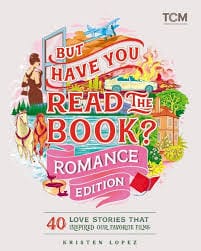
I have a new book dropping on July 28th! It's But Have You Read the Book: Romance Edition! I look at 40 of the most iconic romance novels and their filmic counterparts to show you the changes in between. Preorder your copy now!
Want to Work Together? Improve Your Disability Representation? Learn to Pitch? Book a Consult With Me.


![Renate Reinsve Was Asked Not to Know the Truth in Fjord [Video]](https://storage.ghost.io/c/24/37/24372e80-8819-45cd-8a9d-4dbc679f7337/content/images/size/w600/2026/10/1-3.png)