
Toy Story 5 Review: Playtime is Over in This Tired Installment
Tech struggles to gain a toehold in a franchise that's past its sell-by date

This post is free to enjoy but it's worth it to become part of my exclusive Gold Star Crew of Silver and Gold Film Mavens.
🌟Supporters like: Jacob Haller, Melissa Heeney, Mitch Santell, Jeremy Scholl, Naomi Nelson, Sarah E Wethern, Matt McDaniel, Sofiya Cheyenne, Wiley Sutton, and Rachel Dinga💫 And welcome new Gold Star Crew member Lucie Goulet!
Paid subscribers are the backbone of The Film Maven who support independent journalism, as well as female- and disabled-created content. Paid Film Mavens get access to shout-outs, exclusive articles and series, Zoom mixers, and The Film Maven Discord server.
Preorder my latest book, But Have You Read the Book: Romance Edition? Upload your receipt to the link to get 3 months of Gold Film Maven membership plus a tote bag FOR FREE!
Consider becoming a paid subscriber and joining the community that invests in independent journalism free of AI and influencer opinions!
"The age of toys is over." That may be so, but the age of Toy Story films is certainly not, though it probably should be. It's amazing to think of where Woody, Buzz, and the gang have gone since dazzling us in 1995 with its then (now dated) unique CGI animation and heartwarming storytelling. Toy Story 2 continued on a high note in 1999 before the original trilogy was concluded with 2010's Toy Story 3 which is a perfect conclusion for the franchise. And that's probably where it should have stayed. Though 2019's Toy Story 4 is solid, and has some fascinating disability politics, the emphasis away from the legacy characters to more A-list starts started to fracture what made the original three work so well.
The same problem exists with Toy Story 5, which seems even more adrift at how to tell the same story about toys questioning their existence that hasn't been said before. The fragmented narratives have diminishing returns on interest, and the war between tech and toys ends up remarkably simplistic and twee (especially for a company that has embraced tech for decades). The voice cast still feels game, the ones that are given actual characterization at least, but the entire endeavor can't seem to find its own sense of playtime.
Bonnie, the new owner of the Toy Story crew, is now eight-years-old and seemingly happy. But when her parents buy her a new Lilypad (voiced by Greta Lee) tablet, in the hopes it'll help Bonnie make friends, the toys become threatened by tech. Jessie (Joan Cusack) sees losing Bonnie as akin to losing her original owner, Emily, and sets off on a journey to help the little girl make friends through toys. Thus kicks off an adventure wherein Jessie returns to her original home and must band together with a toddler tech toy called Smarty Pants (Conan O'Brien) to help blend the world of toys and technology.
You'd be surprised to know Toy Story 5 doesn't start with Woody or this film's star, Jessie, but with Buzz Lightyear. Actually, a lot of Buzz Lightyear's. The movie kickstarts with a group of Buzz's (now upgraded to a High Tech Edition) who become trapped on a deserted island. The group bands together to learn words, believing (as Buzz Lightyear's have done for five movies now) that they're meant to rendezvous with Star Command, and build a boat (!) to escape the island. It's the first bit of recycling in a movie that seems to rely on a lot of the greatest hits from this franchise. We've seen the OG Buzz discover who he is, toy store Buzz in TS 2, and Spanish Buzz in TS 3. Guess we need Group Buzz's now.
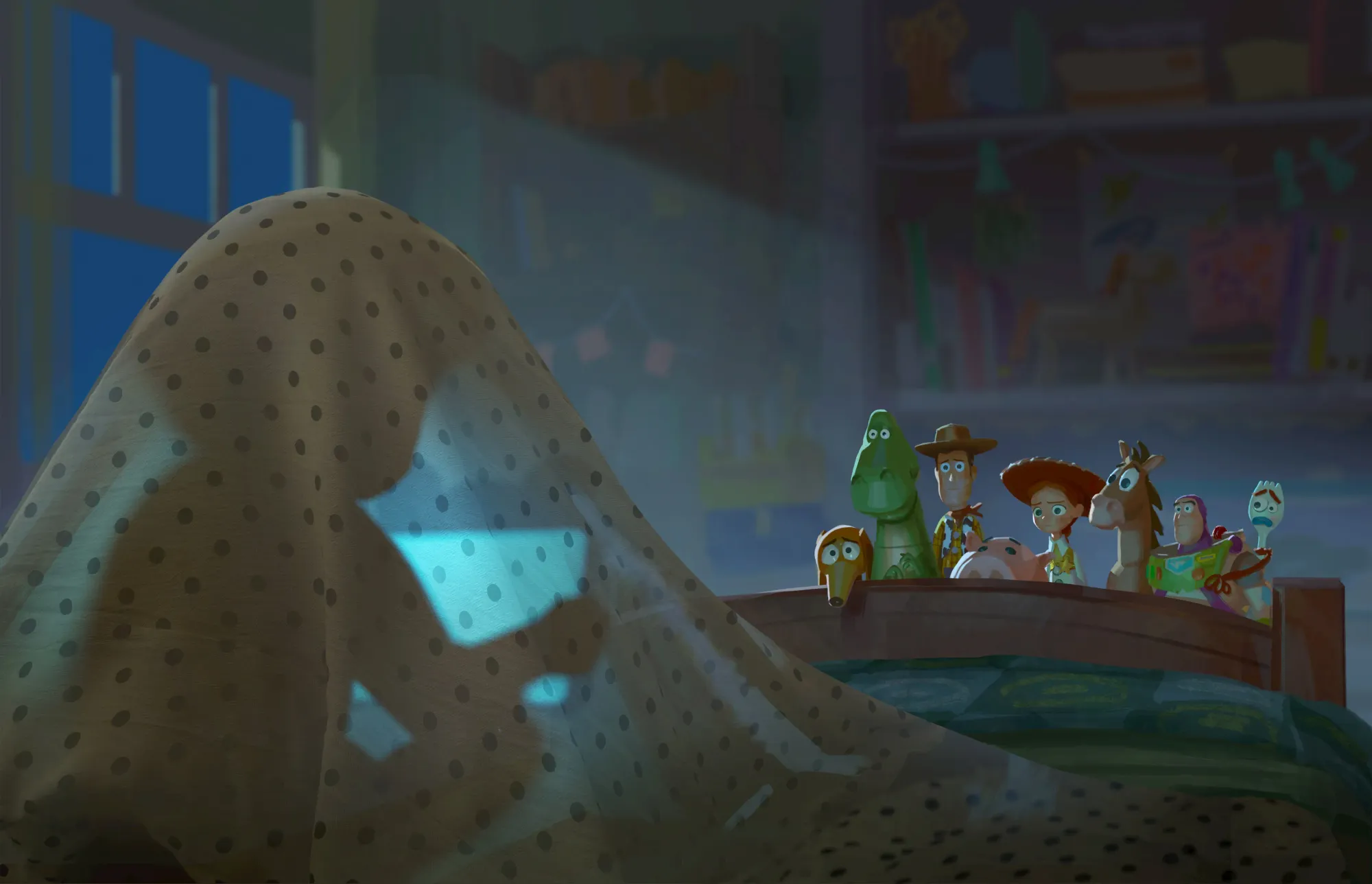
This could have yielded something interesting with its vaguely Small Soldiers premise. The group doesn't understand why they freeze when humans are around and generally feel like offshoots of SkyNet. And yet this traveling group of Lightyears do little more than elongate the runtime and pay off a third-act delivery service. In execution, the movie stops focusing on the main narrative in order to return to this group of wayward Lightyears as they just wander in the hopes of finally tying into the main narrative.
Once that's established we actually get to see our regular characters, namely Jessie, the new sheriff of Bonnie's room. Where the last movie made a point of discussing disability in an unobtrusive way, it's odd that the movie doesn't seem to have any interest into Bonnie's potential neurodivergence. She's unable to make friends with regular kids, speaking through her toys in a way that turns people off. Instead, the movie just reiterates that Bonnie's issues stem from her love of toys to begin with. That in a world where tech forces kids to grow up too quickly, other children just don't have the same sense of childish imagination which, both things could be true at once?
Regardless, Jessie becomes committed to helping Bonnie putting her at odds with Lilypad. Greta Lee's big bad is reminiscent of Toy Story 4's Gabby Gabby, in that the audience is meant to see her as not necessarily villainous, just engaging in a different approach to helping Bonnie make friends. The problems lie in how much heft Lilypad actually has in the story which isn't much. She's passive aggressive, refusing to call Jessie anything other than Jessica, and once Jessie goes off on her solo adventure Lilypad is pretty much left to be interrogated by Buzz and Woody. She's really just there to deliver old man jokes at Woody's expense.
She represents the central flaw with Toy Story 5 that tech is more of an amorphous element in this landscape. It can't be anthropomorphized in the same way specific toys can be. Tech doesn't have a face and a name, it's a pervasive element of modern-day society and that's hard to boil down to one central premise. Toy Story 5, if there's any meaning in it, is found in how it approaches the dichotomy between millennial Disney adults – who grew up on this franchise – and Gen Alpha viewers Disney no doubt is courting with this movie. In a landscape where Bonnies are seemingly unicorns in today's society, Toy Story 5 struggles to figure out whose money they want more. By the third act Lilypad's altruistic about-face seems silly in a landscape where tech certainly isn't going away anytime soon.
In fact, the script doesn't really seem to see Lilypad as anything other than a literal device to get Jessie out of Bonnie's bedroom and back to her childhood owner's home. Once there, she meets Smartypants, a potty training tech toy, and his friends Snappy and Atlas (voiced by Shelby Rabara and Craig Robinson, respectively). O'Brien and Cusack have some great chemistry, akin to Tom Hanks and Tim Allen in the early days of the franchise. The third act reveal that tries to tie things back to Jessie's former owner Emily is effective, if emotionally manipulative in a movie desperate to mine some sort of emotional catharsis from the premise.
The third feature attempted to find a way to say goodbye to the legacy characters, while Toy Story 4's ending tried to give Tom Hanks an opportunity to bow out of future installments. Unfortunately, Disney doesn't seem trusting that the franchise can stand without Hanks, especially, and forces a reason for him to return. His Woody, who had such a solid arc culminating with 4, literally drops in (bald spot and poncho in tow) to act as the film's elder statesman. He doesn't have any reason for being there short to help guide Jessie to the exact same realization he had in Toy Story 3.
 Kristen Lopez
As for the rest of the characters from the first three, and Toy Story 4's Forky, they're all stuck in Bonnie's room waiting around for something to happen to them. The movie's strength has always been the cohesive unit of Buzz, Woody, and the other characters but here, with Disney's desire to create room for more A-list names (and the marketing of new toys), there's little desire to give focus on them. Instead, we're left with new characters that, if the franchise continues, will probably never be heard from again because their voice actors are too expensive or busy to come back. Case in point, Ducky and Bunny, the carnival toys voiced by Keegan-Michael Key and Jordan Peele from the last film, show up here utterly mute.
In a year where Disney gave us the utterly darling, and original, Hoppers, Toy Story 5 feels like a reheated lunch. The film's animated playtime sequences are nice, but the three competing narratives vary in their individual entertainment value leading to an overall movie that's very mixed. It might finally be time to put the toys in the attic.
Grade: D+
Toy Story 5 is in theaters Thursday.
You just read this for free! Here's what you missed by not becoming a Gold Star paid subscriber starting at just $4 a month or $30 a year:
- Access to all my paid content and exclusive series like:
 Kristen Lopez
 Kristen Lopez
- Shout outs on my newsletter when you join and whenever you have something you're launching.
- Included on my Gold Star Crew list
- Bi-Monthly Zoom Mixers where we can talk entertainment, get advice on journalism, and generally discuss the world.
- Access to our Discord server where we can chat about movies and entertainment. It's also where I host my yearly Golden Globes and Oscar watches.
- Participation in my new Film Maven Secret Santa Gift Exchange (launching November 2026), book clubs, and film discussion groups (launching later this year)
Have you preordered my latest book, But Have You Read the Book: Romance Edition? Upload your receipt to the link below to get 3 months of Gold Film Maven membership FOR FREE and a free tote bag!
 Kristen Lopez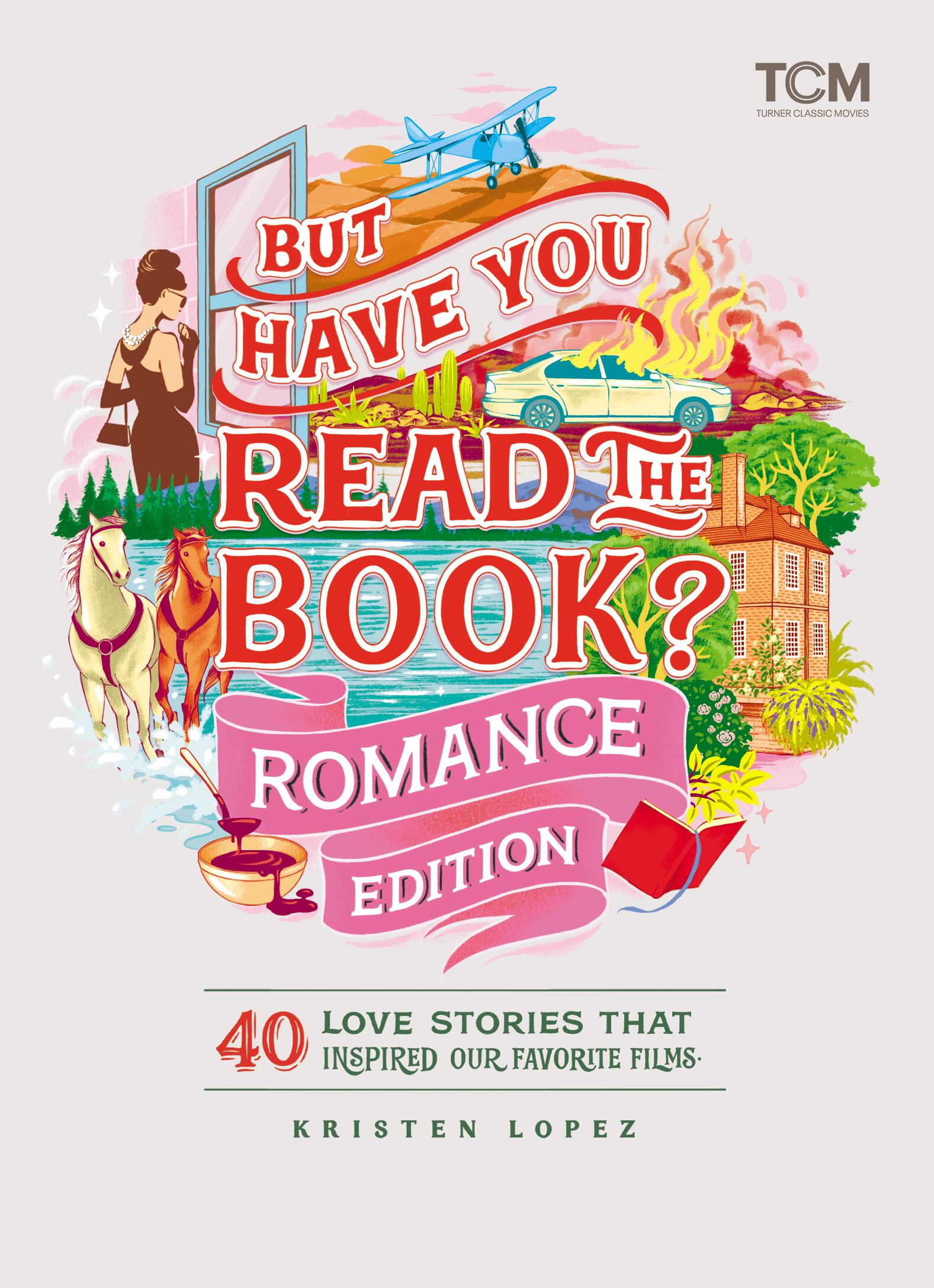


![Thomasin McKenzie Reveals the Dark Backstory She Created for The Uprising [Video]](https://storage.ghost.io/c/24/37/24372e80-8819-45cd-8a9d-4dbc679f7337/content/images/size/w600/2026/09/1.png)
