Wicker Review: The Year's (Actual) Best Movie About Wishing For a Partner
Alexander Skarsgard and Olivia Colman are a new screen team we need more of.

This post is free to enjoy but it's worth it to become part of my exclusive Gold Star Crew of Silver and Gold Film Mavens.
🌟Supporters like: JI, Jo Uhrich, Andrew F. Peirce, Wendy Zaballos, Nadine Whitney, Altus Lee, Libeth Morales, Lucy May, David Fox, and Alexandra Bowser💫
Paid subscribers are the backbone of The Film Maven who support independent journalism, as well as female- and disabled-created content. Paid Film Mavens get access to shout-outs, exclusive articles and series, career mentoring, Zoom mixers, and access to The Film Maven Discord.
Consider becoming a paid subscriber and joining the community that invests in independent journalism free of AI and influencer opinions!
In 2013, the TV series Black Mirror put out "Be Right Back," an episode detailing what happens when a widow gets the opportunity to resurrect her dead husband through the power of AI. It's a sweet, melancholy story that, unfortunately, has aged impeccably well. Women-fronted stories about creating the perfect partner are more infrequent, and in a landscape where something like Obsession continues to illustrate what men prioritize in creating someone to love them, Alex Huston Fischer and Eleanor Wilson's Wicker couldn't be more refreshing. An adaptation of Ursula Wills's short story, Wicker is a hilarious and romantic exploration of gender dynamics that will leave you saying, "Men, what's stopping you from being the Wicker Husband?"
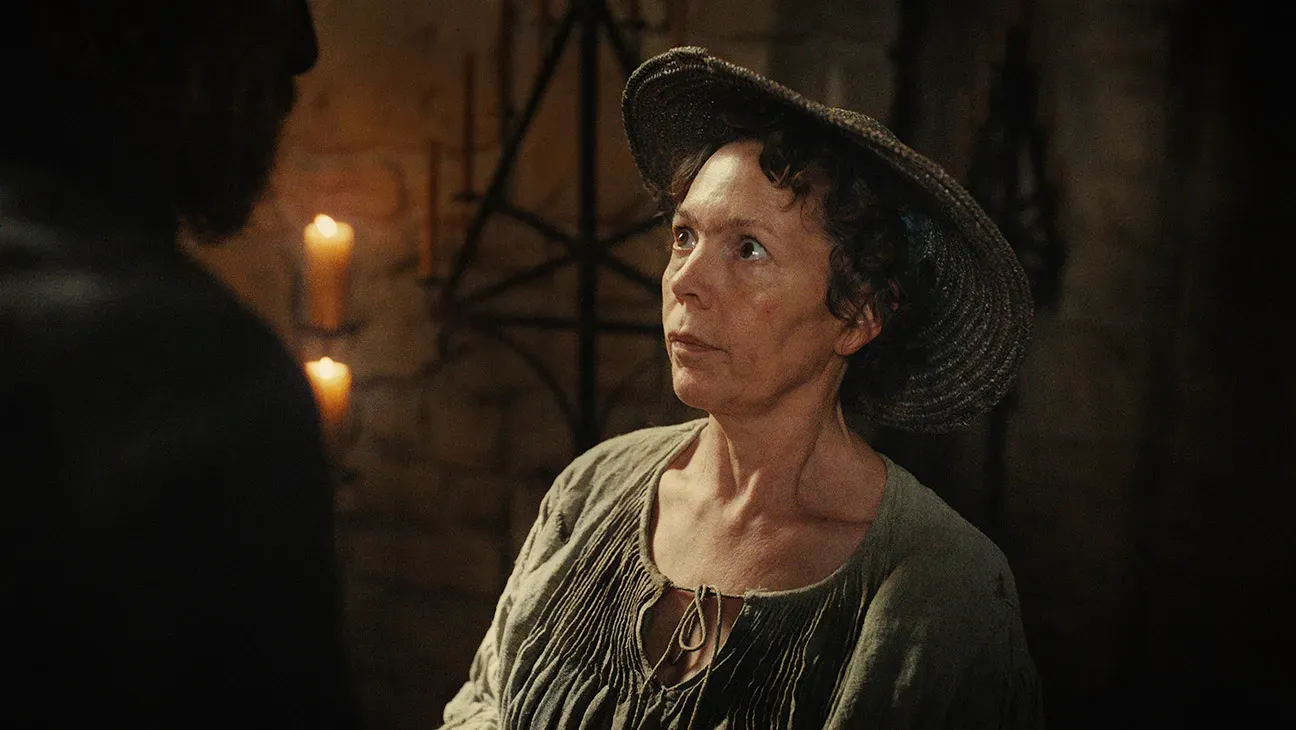
Part fairy-tale, part fable, Wicker tells the story of the lonely Fisherwoman (Olivia Colman), who spends her days being berated by the townsfolk and her nights alone. She enlists the help of a local basket maker (Peter Dinklage) to craft her a husband. The Wicker Husband (Alexander Skarsgard) is utterly devoted to the Fisherwoman, and the pair soon set the town's populace aflutter. But jealousy soon rages in the heart of Tailor's Wife (Elizabeth Debicki) who becomes hellbent on destroying the relationship between the new couple.
Fischer and Wilson, who also wrote the script, crafts a movie simultaneously timeless and of the time. With its Gothic title cards, old-timey setting, and characters exclusively named by their professions, this reductive time frame allows the social commentary to stand out straighter. This is a town where the men literally place a collar around the necks of their new brides, after all. We meet the Fisherwoman on an average day in her life, fielding insults about her smell from the men, while receiving more passive aggressive comments from the women. The Fisherwoman holds her head high and has a catty retort – "lick my worm" is gonna be a catchphrase, mark me – but it's obvious the insults get to her.
Any place where the script could fall into formula, it pivots so skillfully. When Fisherwoman asks the Basketmaker to make her a husband, it could be presented as little more than a magical moment that defies explanation (which, it is). But Dinklage's Basketmaker is no magical disabled character. His dialogue, almost exclusively in monologue, sees him question whether, if he was accepted by the town, would he feel differently to the Fisherwoman's plight? It's a small moment in the film that, as Fischer and Wilson told me, they didn't necessarily think of from a disability lens.
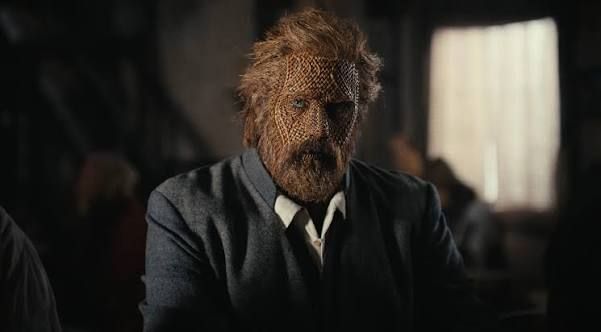
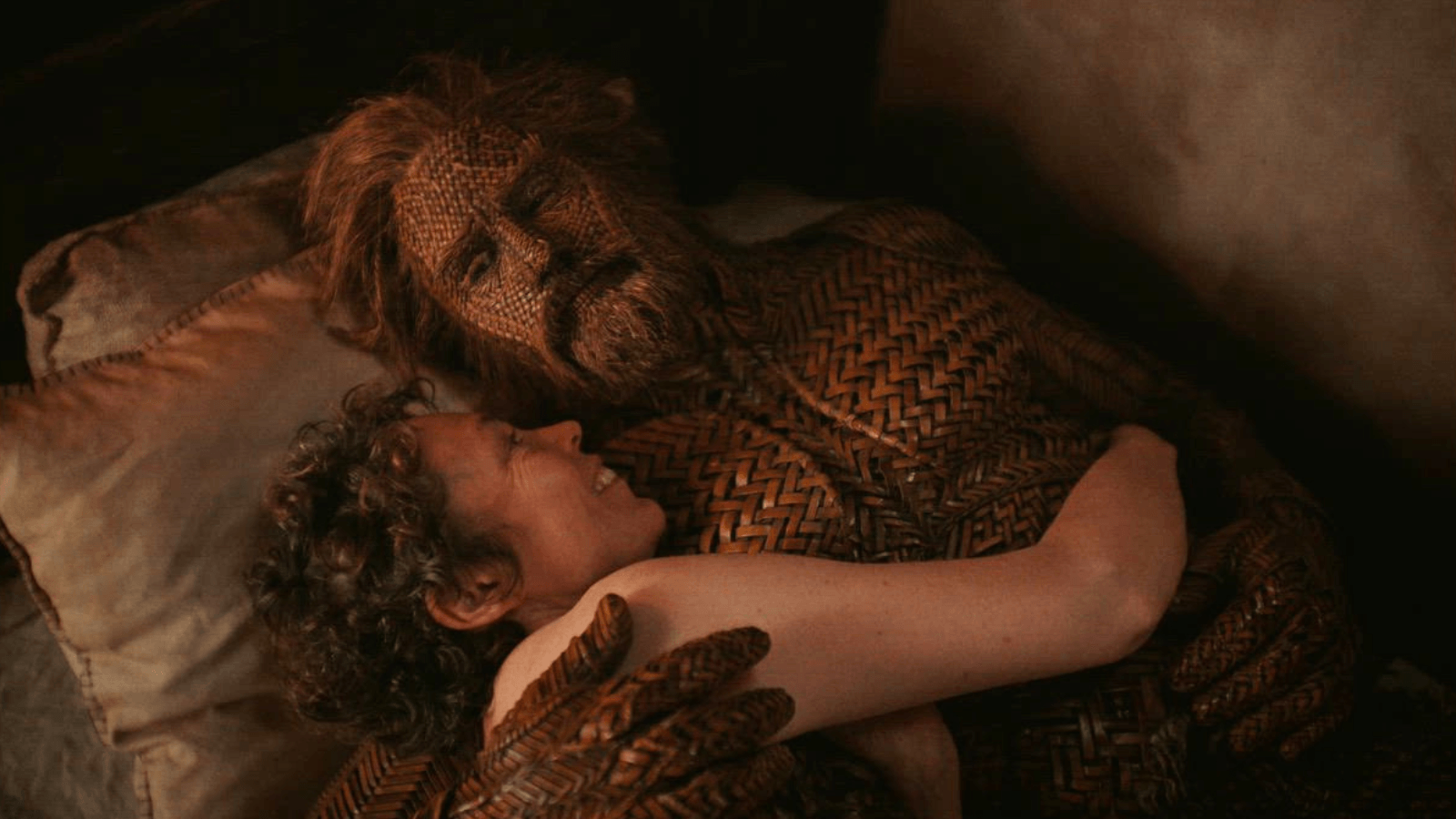
The arrival of the Wicker Husband may be a magical feat for the narrative, but also is a technical marvel from a filmmaking standpoint. Crafted with the help of Weta Workshop, the artistry in the Wicker Husband is fantastic. One can clearly see Skarsgard in there amidst the grain. There's an added layer of beauty in the way the camera lingers on how the wicker bends around Skarsgard's body. On top of that, the sound mix makes a point to emphasize every creak as Skarsgard moves, never making us forget that he's wicker, and yet the viewer eventually doesn't care. The addition of some other spoiler-centric characters gives viewers different ways to appreciate the artistry of the way wicker is used. If the Academy was smart, this would get a visual effects and makeup nomination.
Colman and Skarsgard have a fiery chemistry that carries the film through the absurdities the townspeople dish out. The men and women of the town both spend time asking questions about the Wicker Husband's genitals, and how the couple's sex life, which we get to see play out in hilarious fashion. But as time goes on the women become more compelled by how the Wicker Husband talks to Fisherwoman. Skarsgard voice is tender, compassionate, and direct. The Wicker Husband tells the menfolk that he's happy when his wife is happy, a strange statement to them who see their wives as nagging chattel. The movie, at its core, is about what people need from relationships, and how too often misogyny ends up tearing apart relationships, intentional or otherwise.
And that misogyny infects everyone, particularly Tailor's Wife. Elizabeth Debicki plays a character nearly everyone has met in their lifetime. Someone who smiles at you in your face, but enjoys needling you to induce self-doubt. In this case, unhappy with her small life as the local leader of the women, as well as being a wife and mother, Tailor's Wife starts making Fisherwoman doubt her husband's fidelity. It's silly when said aloud, but that's the movie's ultimate point. "It's easier to believe the bad than the good." Debicki's character isn't evil, per se, but pathetic and sad. Colman's Fisherwoman never lets Tailor's Wife have the upper hand, but it's clear that the comments pain her.
Though Debicki, Skarsgard and Colman are the fulcrum, the rest of the ensemble cast is also perfect. From the Other Bennett Sister, Ella Bruccoleri, as the Baker's Wife, to Marli Sui as Debicki's sister, and Emily Lloyd-Saini (who gives one of the best facial reactions in a film this year), everyone shines. That's helped by the fact the script gives them all personality and character without ever distracting from the central narrative. Each of them focuses on a different relationship element, whether that's the desire for sexual excitement or just a yearning for their partner to say words of gratitude.
The Wicker Husband becomes a fount for every relationship problem that exists, ultimately showing that people want a partner more than anything. As the Fisherwoman struggles with her own self-confidence, fueled by outsiders, it brings up questions of why we're so quick to self-sabotage in our relationships. Would we necessarily know when the perfect partner shows up? Do we, as a society, even still have the capacity to believe in true love? There's a weird kinship between this and something like Rob Reiner's 1987 feature The Princess Bride, both fantastical stories about love transcending all sorts of wacky barriers.
 Kristen Lopez

Reviews for movies I love are the hardest to write, and I fear I haven't done Wicker justice in this review. Wicker is such a sharp, and timely look at relationships, passed through the lens of a beautiful fable about magic and true love. Olivia Colman and Alexander Skarsgard are fantastic. It's funny, sexy as hell, and one of the best movies of the year.
Grade: A
Wicker is in theaters Friday.
If you liked this review, paid Film Mavens get the stuff I can't publish anywhere else:
- Access to all my paid content and exclusive series like:
 Kristen Lopez

 Kristen Lopez

- Shout outs on my newsletter when you join and whenever you have something you're launching.
- Included on my Gold Star Crew list
- Bi-Monthly Zoom Mixers where we can talk entertainment, get advice on journalism, and generally discuss the world.
- Access to our Discord server where we can chat about movies and entertainment. It's also where I host my yearly Golden Globes and Oscar watches.
- Participation in my new Film Maven Secret Santa Gift Exchange (launching November 2026), book clubs, and film discussion groups (launching later this year)