The Social Reckoning Review: Aaron Sorkin's Facebook Sequel Tries to Make Us Care About What Hasn't Changed
Mikey Madison and Jeremy Allen White try to infuse life into Sorkin's political monologuing.

This post is free to enjoy but it's worth it to join my exclusive Gold Star Crew of Silver and Gold Film Mavens.
🌟Supporters like: Bonfiglio, BJ Colangelo, Ashley Eakin, Jessi Parrott, Talleri Mcrae, LMoore, Tonia Steed, Chelsea Meister, Josh Hornbeck, and Julia Mazza💫And welcome new Gold Star Crew members Emma M. Delfosse and Kristin Jamberdino💫
Paid subscribers are the backbone of The Film Maven, supporting independent journalism, female- and disabled-created content, and getting access to content no one else is talking about. Paid Film Mavens get access to shout-outs, mentoring/coaching, exclusive articles and series, Zoom mixers, and swag.
Become a paid subscriber and joining the community that invests in smart independent journalism free of AI and influencer opinions!
In 2010 director David Fincher and screenwriter Aaron Sorkin documented the early days of Facebook in The Social Network. An adaptation of Ben Mezrich's book of the same name, The Social Network was a slick, flashy examination of pettiness and ambition wrapped up in the burgeoning world of social media. And its Oscar play that year, where it competed alongside eventual Best Picture winner The King's Speech, turned into a competition between stodgy, old school filmmaking, and the cinema of the future.
While it's doubtful anyone's thought of The King's Speech in the last sixteen years, people have certainly thought about The Social Network. Particularly as its founder, Mark Zuckerberg, became one of the biggest billionaires on the planet, and is now derided for exhibiting the worst excesses of corporate greed alongside the likes of Elon Musk. Sorkin himself has apologized for making the film's interpretation of Zuckerberg, that of an angry young man whose social awkwardness failed to impress one single girl he knew, more sympathetic considering what's happened now. (Though, he's also apologized to Zuckerberg for "hurting his feelings" so, go figure.) The Social Reckoning is a continuation of Sorkin's cinematic mea culpa.
The Social Reckoning is not as good as The Social Network. Then again, it's not trying to be. The 2010 film was a David Fincher movie that had a Sorkin script. A strong directorial voice can smooth Sorkin's penchant for big political pontificating with an engaging story. With Sorkin pulling double duty as director and screenwriter, The Social Reckoning becomes heavy on the preaching and light on the characterization. What results over the near two-hour runtime are a series of cinematic archetypes masquerading as characters in a vein attempt to do a contemporary take on All the President's Men (1976). It's entertaining for about two-thirds of the movie, even if the dialogue is so dense with tech speak you'll wonder what the actual plot is, before running out of steam in the final act as, historically, nothing really changed for anyone.
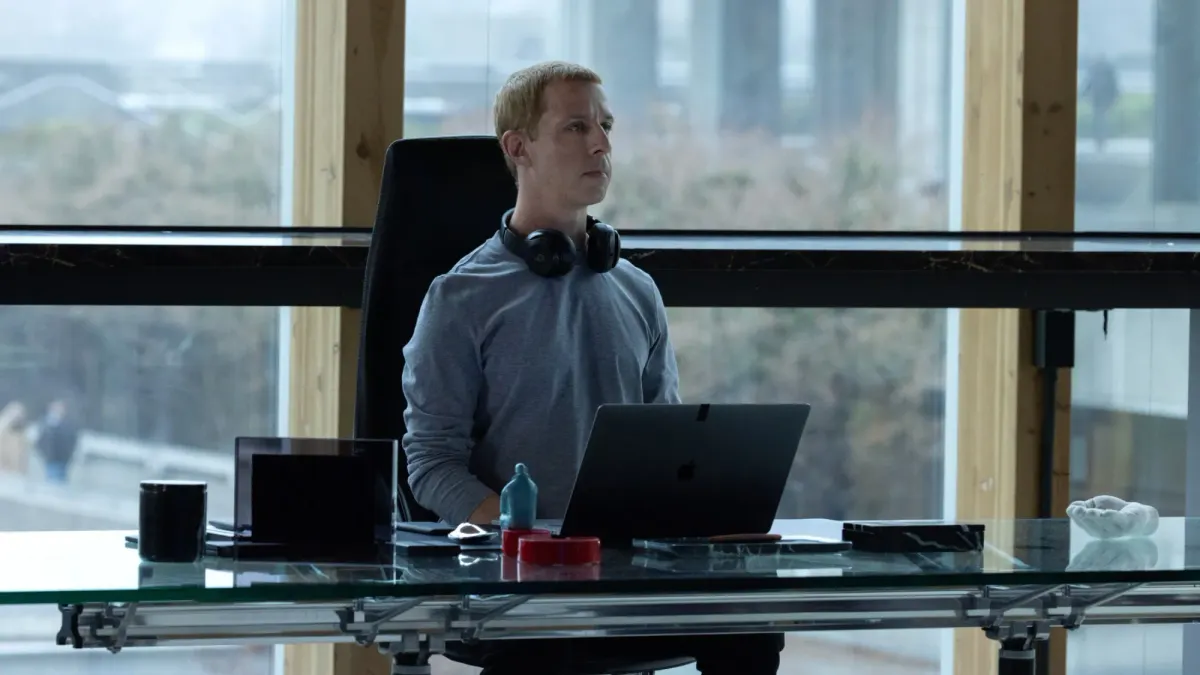
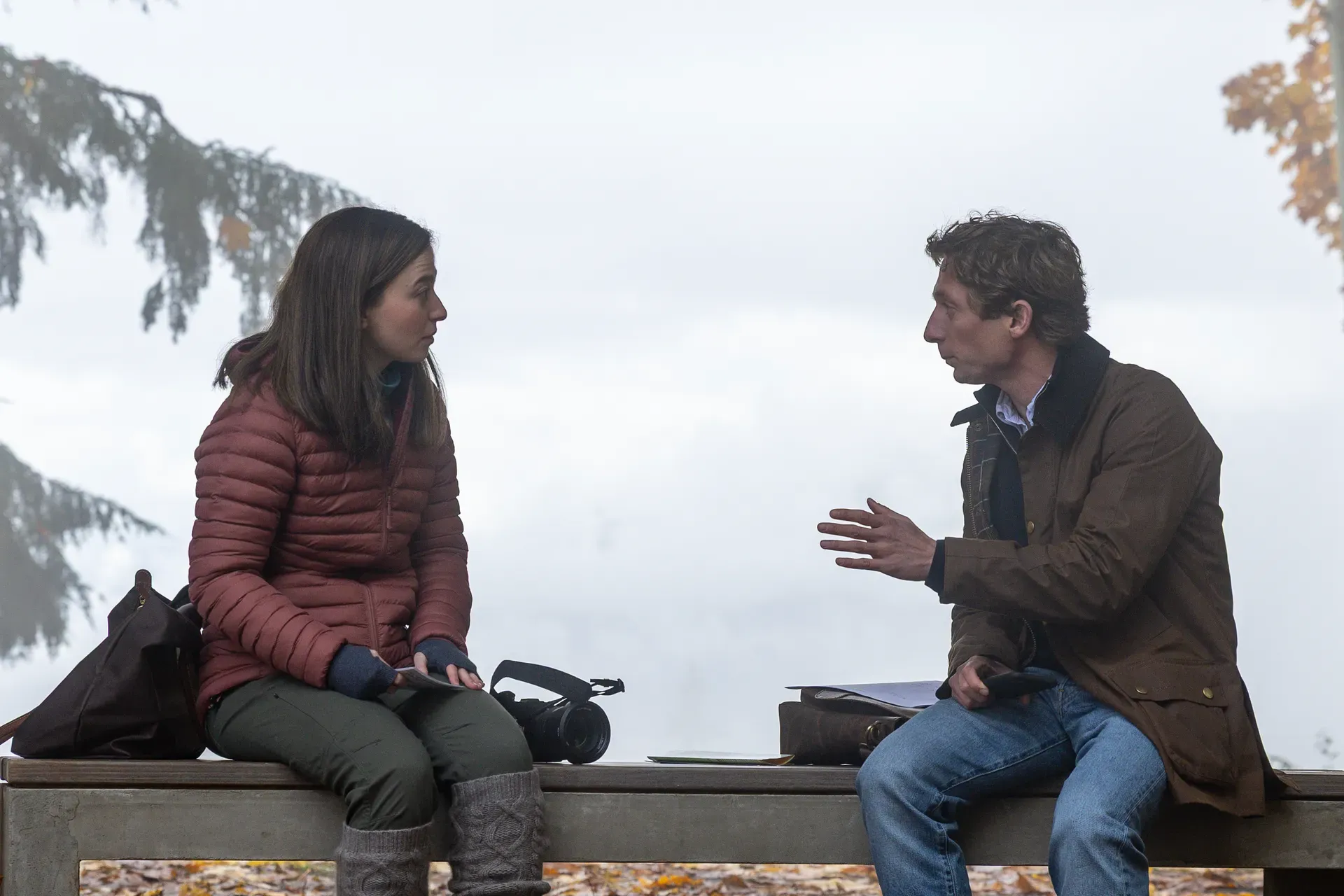
Taking place over a four year period, the film follows Frances Haugen (Mikey Madison, a member of Facebook's Civic Integrity Team, responsible for monitoring and cleaning up disinformation on the platform. Unable to get anyone to care about the large uptick in hate speech and other lies proliferating on the service, she reluctantly approaches Wall Street Journal writer Jeff Horwitz (Jeremy Allen White). Together, the two seek to blow the lid off Facebook's desire to fuel engagement through inflammatory content and tie it back to the company's CEO, Mark Zuckerberg (Jeremy Strong).
The Sydney Lumet/All the President's Men comparisons start from moment one, as Alexandre Desplat's patriotic orchestral score immediately evokes similarities to David Shire's iconic music from that film. But instead of Frances Haugen, we're first treated to a section entitled "Prologue" and a young drunk girl named Kayleigh (Portia Doubleday) going on a racist rant online while standing in front of two police officers of color. This increasingly taut, and all-too real moment, goes on for a good ten minutes of screen time before we're thrust into 2019 and the actual first part of the movie, titled "Cassandra." These episodic titles imply a movie that doesn't necessarily know how to connect these disparate threads, probably because unlike the first film, which had source material, Sorkin is cobbling things together from a bevy of different articles to tell a story where the ending isn't really defined.
In Sorkin's worldview, there's a clear through line between the rise of racism and anti-immigration all the way to the January 6th insurrection and it's Mark Zuckerberg. It's a very simplistic thesis, especially if you lived through that time and understood that Facebook was far from the only place people were getting disinformation and seeing hate speech, but it's clearly where Sorkin's head is at. He wades through the dense world of Facebook code speech, establishing terms like MSI (meaningful social interaction) and other verbiage in a breathless manner that compels you to pay extreme attention or else lose the thread completely.
Each of the three main characters have clearly delineated plot lines, and are never in the same room (or plot line at the same time). Haugen is poised to be our heroine. Sorkin seeing her on the same level as Daniel Ellsberg or similar whistleblowers, the only paranoia or fear of reprisal comes from Frances herself. Mikey Madison, with shortened hair and a modulated yet mousy voice, plays Frances as a socially awkward wallflower. One who seemingly has no friends, lives alone, and struggles with neuropathy due to celiac's desire which requires her to be covered in a sheer mist of flop sweat the entire movie. All the characters have one bit, Sorkin's attempt to make them actual people, so in this case Frances spends her free time cruising a dating site and questioning why she can't find a man. Then again, all the men she interacts with at Facebook cast her aside, while reminding her to go on said dating site....can't fathom why she's avoiding it.
Madison is fine, as are Strong and White, but there's little heft to her. Frances goes through a rote series of plot beats: she meets Jeff. Tells him how much she loves her job and believes in Facebook. Gives him a little info. Refuses to give him more. Gives him more. Demands she's done (complete with thrusting the burner phone he's given her in his hand). Repeat. There's little momentum as to why Frances is so compelled to blow the lid off Facebook, and while Sorkin attempts to give her a personal connection, these moments play as silly. One attempt directly calls back to Little Miss Racist in the prologue, while another is an awkward scene where Frances interrupts a family at dinner whose daughter is struggling with bullying on Instagram, only to have the father unleash on Frances to "shut the website down." Yes, sir, a lowly Facebook employee can certainly shut down the entirety of Instagram. No prob. By the time Frances finally does have a come to Jesus moment it's off-screen, giving the viewer no reason to cheer for her.
Horwitz is defined even less. Like any journalist written by someone who doesn't know the field, Jeff is presented as a tech-averse writer (he doesn't know how to work GPS) set to become the lead tech investigative reporter for the Wall Street Journal. He also has no life outside of his job, demanding his unpaid interns blow off school to be at his beck and call, and randomly shows how much he loves Old Hollywood musicals. Again, these don't feel like organic personal facts, more so as ham-fisted attempts by a screenwriter to make a person likable. White, also modulating his voice, is fine but there's little required of him to stretch as an actor.
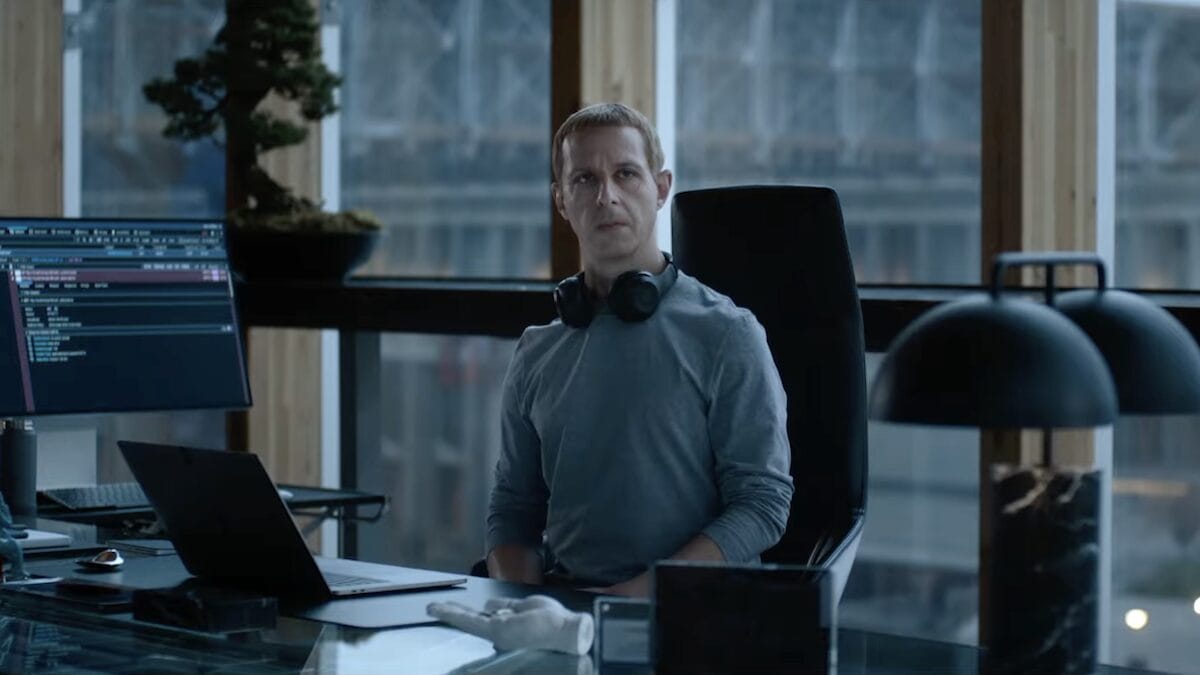
And then there's Strong's Zuckerberg. What made Jesse Eisenberg work so well, was that Zuckerberg knew he was an asshole and, in Sorkin's mind, desperately wanted not to be. Here, Strong's Zuckerberg is an asshole. Period. Sure, there's one stray reference to how much the negative press hurts his wife and kids, but it feels more like Sorkin's own apology to Zuckerberg written into the script as an acknowledgement. Strong's performance is bird like, his nose constantly in the air. He's a complete cypher, unknowable in the way people with billions of dollars often are. Yet Sorkin never attempts to give us any insight into Zuckerberg's mindset. Hell, he doesn't even go so far as to just say the man is greedy. He turns him into a cheesecloth thin Big Bad.
 Kristen Lopez
By the time the movie draws to its conclusion, complete with a recreation of the January 6th insurrection – and one of the most groan-inducing Sorkin moments committed to screen....you'll know it when you see it – it's really unclear what is meant to be exposed. Yes, social media has destroyed us as a society, but that's an amorphous problem not relegated to one social media network, and Sorkin seems to forget that. He narrows the landscape of social media so much that it ignores a variety of other factors. By the time the on-screen text talks about consequences, it reads like a struggle to find something, anything, to explain why this movie exists. Particularly as we now know that Facebook faced zero real consequences, certainly less so now.
There are some great books worth reading on this story, from Horwitz's own Broken Code to Christopher Wylie's Mindf*ck. Some situations don't feel like they're worthy of a movie and The Social Reckoning is a prime example. The movie never feels as vital, sweeping, controversial, or important as Sorkin thinks it is. Especially considering that Meta's power has only increased. Sure, it puts the awareness on us as viewers to look closer at the social media we're consuming, but in a landscape where AI and social media are only growing, is anyone really going to listen? On its own, it's a solid film with decent performances, but nothing that really makes you say, "Wow."
Grade: C-
The Social Reckoning is in theaters Friday.
If you liked this review, paid Film Mavens get the stuff I can't publish anywhere else:
- Access to all my paid content and exclusive series like:
 Kristen Lopez
 Kristen Lopez
- Shout outs on my newsletter when you join and whenever you have something you're launching.
- Included on my Gold Star Crew list
- Bi-Monthly Zoom Mixers where we can talk entertainment, get advice on journalism, and generally discuss the world.
- Access to our Discord server where we can chat about movies and entertainment. It's also where I host my yearly Golden Globes and Oscar watches.
- Participation in my new Film Maven Secret Santa Gift Exchange (launching November 2026), book clubs, and film discussion groups (launching later this year)